
Miracle Chrysler Dodge Jeep Ram
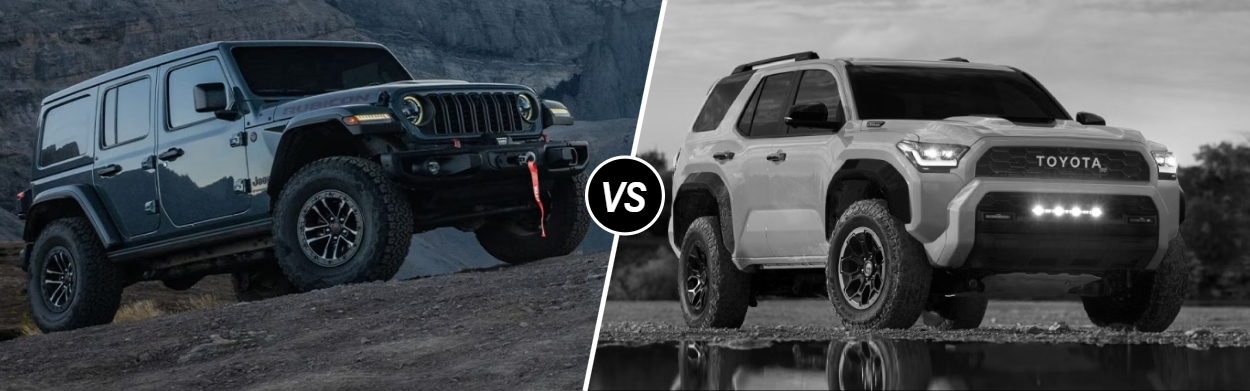
If you’re weighing 2026 Jeep Wrangler vs 2026 Toyota 4Runner, here’s the big picture. Both SUVs are body-on-frame legends that love a challenge, but the Wrangler leans hard into customizable, open-air adventure, while the 4Runner chases modern tech and a family-friendly cabin. Jeep® builds capability into the Wrangler DNA: every model is Trail Rated®, doors and roof come off with quick-release hinges, and signature 4×4 systems like Command-Trac®, Selec-Trac®, and Rock-Trac® keep the traction conversation serious. Toyota counters with a new-generation 4Runner offering available Full-Time 4WD, a TNGA-F chassis, and off-road tools like a Stabilizer Disconnect Mechanism. For drivers who want to feel the environment as much as conquer it, the Wrangler’s removable top and doors, available Sky One-Touch® power top, and 35-inch tire availability create experiences a closed-roof SUV cannot match. As your local Jeep experts in Elverson, PA, we at Miracle Chrysler Dodge Jeep Ram focus our recommendations on real capability and real enjoyment—on- or off-road. When adventure is a lifestyle, not a weekend, the Wrangler’s blend of rugged hardware and everyday tech makes it the stronger fit.
| Feature | 2026 Jeep Wrangler | 2026 Toyota 4Runner |
|---|---|---|
| Trail Rated® badge across all models | Yes | No |
| Removable doors and roof (quick-release hinges) | Yes | No |
| Available 35-inch tires from the factory | Yes | No |
| Manual transmission option | Yes | No |
| Front and rear solid axles | Yes | No |
| Best-in-Class available approach angle (up to 47.4 degrees on 4-door) | Yes | No |
| Factory-installed WARN® winch available | Yes | No |
| Full-time 4×4 system available | Yes | Yes |
| Flat-towable behind an RV when properly equipped | Yes | No |
| Sky One-Touch® power top available | Yes | No |
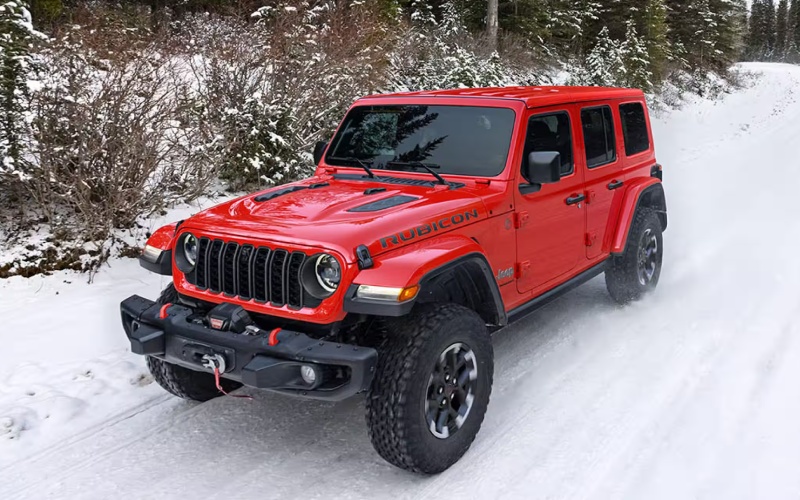
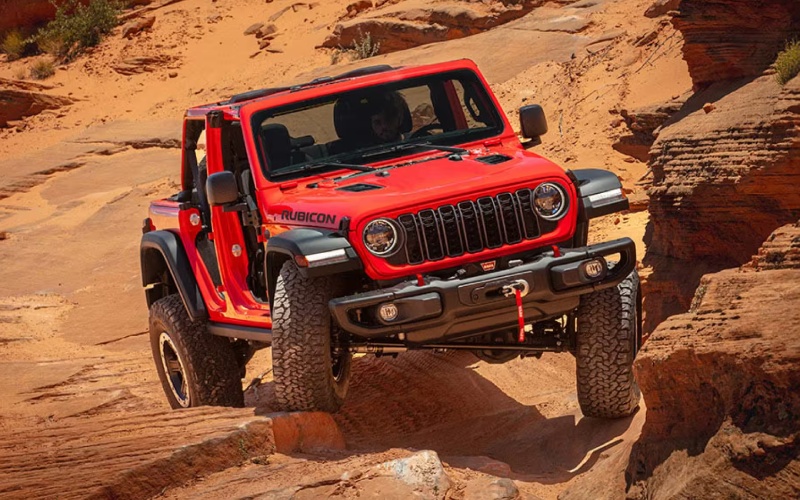
Wrangler’s exterior isn’t just iconic—it’s functional, from the seven-slot grille to the high-clearance fenders and purposeful bumpers. New quick-release door hinges require no tools, so you can go from sealed to sky in minutes. Top choices range from the versatile Freedom Top® three-piece hardtop to the Premium Sunrider® soft top to the show-stopping Sky One-Touch® power top, which opens wide with the press of a button. Available steel bumpers, factory rock rails, and an available factory-installed WARN® winch with 8,000-pound capacity add rugged utility that plays well with real-world recovery scenarios. On select models, massive 35-inch tires and steel skid plates help conquer breakover challenges with confidence. Toyota’s 4Runner emphasizes fresh sheetmetal with widened overfenders on TRD Pro and Trailhunter, up to 33-inch tires, premium LED headlights, and up to 10.1 inches of ground clearance. Useful utility touches like an available onboard air compressor demonstrate Toyota’s overlanding focus. Still, only one of these SUVs lets you remove both doors and roof for genuine open-air driving. If the exterior is a promise about what the SUV is built to do, Wrangler’s promise is unambiguous: it’s built to engage the outdoors on your terms.
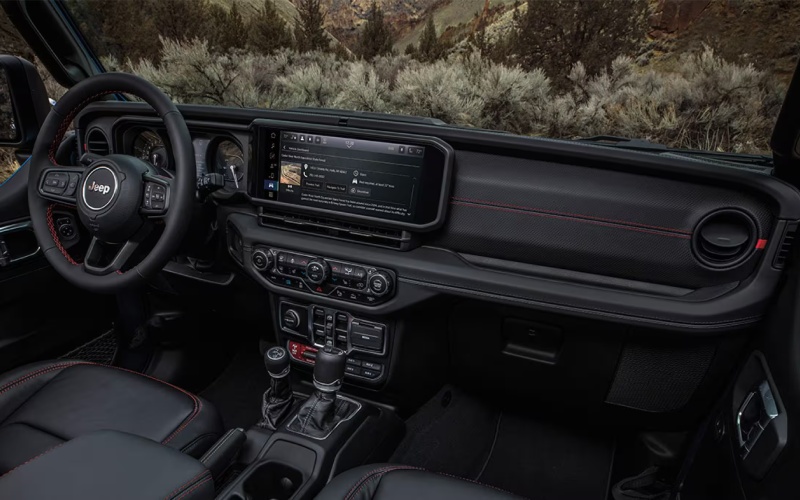
Inside, Wrangler proves that purposeful can still feel polished. The cabin centers around an available Uconnect® 5 NAV with a 12.3-inch center display, wireless Apple CarPlay® support, and Android Auto™ compatibility for intuitive, fast responses and crisp graphics. Seating ranges from durable cloth to available leather, with useful touches like washable materials and smart storage solutions developed over decades of real-world feedback. Dual-zone automatic climate control is available, as are heated front seats on select trims, so the open-air freedom doesn’t have to come with compromises in daily comfort. Toyota’s 4Runner returns with a technology-forward interior of its own—up to a 14-inch touchscreen, available Multi-Terrain Monitor, and useful cargo solutions like tumble-fold rear seats and a signature power rear window. Where the two diverge is personality: Wrangler’s cabin is designed to transform. Quick-release door hinges and multiple top options turn the cabin into a mobile lookout, a star-gazing nook, or a photo platform at a trailhead. In practice, that means you can tailor airflow, view, and experience to every drive, whether you’re skirting French Creek trails or shuttling friends to dinner from Reading and Pottstown. Few cabins invite you to participate in your surroundings the way this one does.
Under the skin, Wrangler separates itself with hardware chosen for trail performance. Solid front and rear axles provide robust articulation and durability, the kind that matters when one side of the vehicle is perched, and the other needs traction. Wrangler Rubicon models bring the Rock-Trac® 4×4 System with a 4:1 low gear ratio and an available 100:1 crawl ratio when paired with the manual transmission and available 4.88:1 axle ratio. Available front and rear Tru-Lok® electronic locking differentials, an Electronic Sway Bar Disconnect, and a heavy-duty full-float rear axle equip the Wrangler to climb, descend, and traverse with uncanny control. And because Jeep positions radar sensors over the rearview mirror, Wrangler can keep available Adaptive Cruise Control while still running trail-ready steel bumpers up front—no need to choose between tech and toughness. Toyota’s 4Runner arrives on the TNGA-F body-on-frame platform, with an available Stabilizer Disconnect Mechanism to increase suspension articulation and available Full-Time 4WD for set-it-and-forget-it traction. The difference shows when you add it all up: 4Runner is impressively capable, but Wrangler is engineered around mechanical grip and modularity, a boon for drivers who plan to learn and grow on challenging terrain.
Wrangler offers two proven engines designed for different driving styles. The celebrated 3.6L Pentastar® V6 with Engine Stop/Start delivers 285 horsepower and 260 lb-ft of torque, available with a manual or automatic transmission across popular trims such as Sport, Willys, and Rubicon. For drivers who prefer strong low-end response, the 2.0L Turbo I4 with 270 horsepower and 295 lb-ft pairs with an 8-speed automatic and offers stout mid-range pull on steep grades and rocky climbs. Critically, Wrangler’s available manual transmission gives you precise low-speed control on the trail, especially useful when working a line over ledges or easing through deep ruts. Toyota’s 4Runner answers with a turbocharged 2.4L i-FORCE rated at 278 horsepower and 317 lb-ft, plus an available i-FORCE MAX hybrid system that boosts output further and smooths throttle inputs off-road. That hybrid torque is enticing, but it’s matched against Wrangler’s breadth of gearing and transfer-case choices, including Command-Trac®, Selec-Trac®, and Rock-Trac®, each tuned to a different adventure brief. If you care most about connected feel, clutch control, and selectable gearing, the Wrangler powertrain lineup is the one that rewards skill and invites confidence.
Modern safety is table stakes, and both models deliver. Wrangler brings a high-strength steel frame, advanced multistage front airbags, and available driver-assist features, including Forward Collision Warning with Active Braking and Adaptive Cruise Control. Parking aids and Blind-Spot Monitoring are available, and the clever relocation of radar sensors away from the front bumper helps preserve off-road hardware without sidelining driver assistance. Wrangler’s visibility advantage when you remove the top and doors is more than a mood—having an unobstructed view of obstacles can be a meaningful safety edge during technical maneuvers. Toyota equips the 4Runner with Toyota Safety Sense 3.0, including Pre-Collision System, Lane Tracing Assist, and more. Available Multi-Terrain Monitor camera views help place tires accurately, and an available Tow Technology Package adds trailering confidence. On the capability side of safety, the Wrangler’s Trail Rated® status signals strengths in Traction, Water Fording, Ground Clearance, Articulation, and Maneuverability—attributes honed on punishing test loops. Whether you’re heading to a trailhead after work or taking the long way home along unpaved stretches, both SUVs help, but Wrangler’s hardware-first approach keeps control in your hands.
If you want capability, you can feel every day in Elverson, PA—and a team that knows how you use it—our staff at Miracle Chrysler Dodge Jeep Ram is ready to help you configure the perfect build.
Put simply, the 2026 Jeep Wrangler vs. the 2026 Toyota 4Runner comes down to what you value most. If you want the latest big screen and an available hybrid’s smooth torque, Toyota’s 4Runner line is undeniably appealing. But if you want the SUV that’s purpose-built to be modified, opened to the sky, and tailored to technical driving with serious axles and transfer cases, the Wrangler is the one that turns plans into stories. Every model is Trail Rated®, the approach angle is best-in-class on 4-door models at up to 47.4 degrees, and factory options like an available WARN® winch or 35-inch tires show that Jeep engineers understand real-world recovery and clearance. It’s also flat-towable when properly equipped, which makes it a favorite for RV travelers. As your Jeep destination in Elverson, PA, we know how and where you’ll drive—and why that matters when you choose gear and trims. Visit us at Miracle Chrysler Dodge Jeep Ram in Elverson, PA, to see how the Wrangler’s open-air design and trail-savvy hardware fit your life. We’re here to help you build not just an SUV, but a way to explore.